
Your business wants to respond to customers faster, reduce repetitive work, and make better use of artificial intelligence.
But should you invest in an AI chatbot or an AI agent?
Both technologies can communicate with customers, understand questions, and use business information. Yet they differ in how they handle tasks, make decisions, and interact with your systems.
Choosing the wrong solution can leave you paying for capabilities you don’t need or relying on software that cannot complete the work you expect.
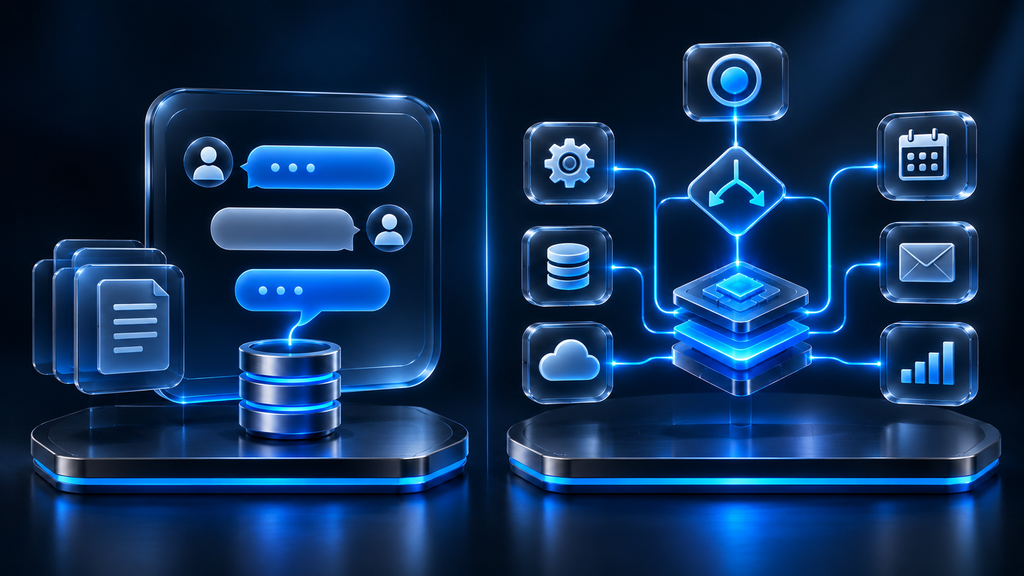
The main difference is this: a chatbot primarily manages conversations, while an AI agent can work toward a goal by choosing and carrying out actions across connected systems.
That distinction isn’t absolute. Some chatbots can perform actions, and some AI agents use chat interfaces.
What matters is the work your business needs to complete.
This guide compares AI agents vs chatbots, explains their strengths and limitations, and helps you decide which approach fits your business.
AI Agents vs Chatbots: The Quick Answer
An AI chatbot is software designed to interact with people through conversation. It can answer questions, provide information, collect details, and guide users through defined processes.
An AI agent is a system designed to accomplish a goal. It can interpret information, select steps, use connected tools, and perform approved actions to complete a task.
Consider a customer asking about an appointment.
A chatbot might explain your services, share booking instructions, or direct the customer to your calendar.
An AI agent could check availability, collect the necessary details, request the appointment, update your CRM, and send a confirmation through connected systems.
A well-connected chatbot can also trigger a booking workflow. The difference becomes clearer when the system must independently decide which steps to take as circumstances change.
AI agents vs chatbots at a glance
| Feature | AI Chatbot | AI Agent |
|---|---|---|
| Primary purpose | Communicate and assist | Complete goals and tasks |
| Main interaction | Conversation | Goal-driven actions |
| Decision-making | Answers or follows defined flows | Can select steps based on context |
| Task complexity | Often simple or bounded | Often multi-step and variable |
| Connected tools | Optional | Commonly required |
| Business data access | May retrieve information | May retrieve and update information |
| Human supervision | Needed for exceptions | Needed for permissions, actions, and exceptions |
| Typical cost | Often lower for simple use cases | Often higher for complex workflows |
| Best fit | FAQs, guidance, information collection | Lead processing, case handling, workflow coordination |
Neither technology is automatically better.
The right choice depends on whether your business primarily needs answers, actions, or both.
What Is an AI Chatbot?
An AI chatbot is a conversational software application that responds to messages from customers, employees, or website visitors.
Chatbots can operate on websites, messaging platforms, customer support portals, and internal company systems.
There are several common types.
Rule-based chatbots
These follow predefined questions, menus, and responses.
For example, a visitor might choose:
- Learn about services.
- Check opening hours.
- Contact support.
- Book an appointment.
The chatbot directs the visitor through the selected path.
Rule-based chatbots work well when the questions and answers are predictable.
AI-powered chatbots
These use artificial intelligence to understand questions written in natural language.
A customer doesn’t need to select an exact menu option.
They might ask:
“Can your team help us redesign our website and connect it to our CRM?”
An AI-powered chatbot can interpret the question and provide a relevant response using approved business information.
Some AI chatbots can retrieve information from documents or trigger predefined workflows.
When is a chatbot useful?
A chatbot can be a good starting point when your business wants to:
- Answer frequently asked questions.
- Explain products or services.
- Help visitors find information.
- Collect basic enquiry details.
- Guide customers through a defined process.
- Direct complex requests to a person.
If your main goal is to help customers get answers without waiting for staff, a chatbot may be enough.
Explore how AI agents and chatbots can support customer communication and business workflows.
What Is an AI Agent?
An AI agent is software that uses artificial intelligence to work toward a defined goal.
Instead of only generating a response, it can determine which approved actions are needed and use connected tools to perform them.
For example, a business might give an agent the following objective:
“Review new enquiries, identify qualified prospects, update our CRM, and route each lead to the appropriate team member.”
To complete that task, the agent might:
- Read an incoming enquiry.
- Identify the requested service.
- Check whether essential information is missing.
- Ask the prospect a follow-up question.
- Review the response against qualification criteria.
- Create or update the CRM record.
- Notify the appropriate salesperson.
- Record the outcome.
The system may need to adjust its next step based on the information it receives.
That ability to select actions within defined limits is a key characteristic of agent-based systems.
Does an AI agent work independently?
It can, but the level of independence depends on how the system is designed.
An agent might prepare an action for human approval, execute low-risk actions automatically, or stop when a request exceeds its permissions.
For business use, unrestricted independence is rarely the goal.
The goal is to let the system complete suitable tasks while maintaining control over sensitive decisions.
6 Key Differences Between AI Agents and Chatbots
1. Purpose: conversation vs task completion
A chatbot primarily helps someone communicate with a business or access information.
An AI agent focuses on achieving an outcome.
Chatbot example: A visitor asks about your website development services and receives an explanation.
AI agent example: A visitor describes a project, and the agent collects requirements, categorizes the enquiry, creates a CRM record, and prepares the next step.
The chatbot supports the conversation. The agent supports the wider task.
2. Decision-making
Many chatbots follow predefined conversational flows or generate answers from available information.
An AI agent can select among approved actions based on the situation.
For example, an agent processing customer enquiries might decide whether to request more details, check an existing record, or escalate the case.
That flexibility can be useful when every request is slightly different.
It also creates a greater need for testing and oversight.
3. Ability to take action
A chatbot can provide information without changing anything in your business systems.
An agent is often designed to interact with those systems.
Depending on its permissions, an agent might:
- Create CRM records.
- Update customer information.
- Check calendar availability.
- Open support tickets.
- Retrieve order information.
- Prepare customer notifications.
Some advanced chatbots can perform these actions too.
The distinction is whether the system follows a fixed conversational workflow or can choose and coordinate actions toward a goal.
4. Workflow complexity
Chatbots often work well for bounded interactions.
For example:
Customer asks a question → Chatbot retrieves information → Chatbot responds.
AI agents are more useful when the process involves multiple decisions.
For example:
Customer submits a request → Agent identifies the issue → Checks relevant records → Selects an approved action → Updates a system → Verifies the result.
The more variable the process, the more useful agent-based capabilities may become.
5. Connections to business software
Both chatbots and agents can connect to external software.
The difference is often how extensively they use those connections.
A chatbot might retrieve information from a knowledge base.
An agent might retrieve information, compare records, select a next step, and update an application.
For businesses using multiple platforms, this can connect naturally with CRM and marketing automation.
6. Cost, maintenance, and risk
A basic chatbot can be relatively straightforward to configure when it only needs a small set of approved answers.
A multi-step AI agent may require more planning, software connections, permission controls, testing, monitoring, and maintenance.
Agents may also make more AI model requests and tool calls to complete one task.
That can increase operating costs.
More capability is useful only when the business value justifies the added complexity.
When Should Your Business Use an AI Chatbot?
Choose a chatbot when the main problem involves answering questions or guiding users through predictable interactions.
Scenario 1: Website customer enquiries
Your website receives repeated questions about services, opening hours, availability, and contact details.
A chatbot can respond using your approved business information.
Best fit: AI chatbot.
Scenario 2: Product information
Customers want help understanding product features, delivery options, or basic policies.
A chatbot can retrieve relevant information and explain it conversationally.
Best fit: AI chatbot connected to a maintained knowledge base.
Scenario 3: Internal employee questions
Employees repeatedly ask about company policies, onboarding instructions, or internal procedures.
A chatbot can help them locate answers from approved documentation.
Best fit: Internal knowledge chatbot.
Scenario 4: Basic appointment guidance
A customer needs to know how to book an appointment.
The chatbot can provide instructions or open an existing booking page.
Best fit: Chatbot or a simple automated booking workflow.
You don’t need an AI agent merely because a chatbot can connect to a calendar.
If the booking process follows fixed rules, a simpler system may be sufficient.
When Should Your Business Use an AI Agent?

Choose an AI agent when the work requires interpreting information, selecting actions, and coordinating multiple steps.
Scenario 1: Lead qualification and CRM updates
Your business receives enquiries through website forms, email, and other channels.
Someone must review each request, identify the service needed, collect missing information, and update the CRM.
An AI agent could handle approved parts of that process.
Best fit: AI agent connected to your lead intake and CRM systems.
Scenario 2: Customer support case handling
A customer reports an issue that requires checking account information, reviewing previous interactions, and opening a support case.
A chatbot might explain the support process.
An agent could gather the required information and carry out approved steps across the relevant systems.
Best fit: AI agent with defined permissions and human escalation.
Scenario 3: Multi-step business operations
Your team receives documents or emails that require classification, information extraction, record updates, and internal notifications.
An AI agent may help coordinate these tasks when the next step depends on the contents of each request.
Best fit: An agent working alongside business process automation.
Scenario 4: Customer call handling
Your business wants to answer calls, identify caller needs, collect details, and arrange appropriate follow-ups.
An AI voice agent may be suitable when conversational interaction needs to connect with business actions.
Explore our AI Voice Agents service to understand how voice-based systems can support customer communication.
Best fit: AI voice agent with approved tool access, clear caller disclosures, and human handoff options.
AI Agents vs Chatbots: Which Is Better for Your Business?
Use this decision matrix to identify the simplest suitable approach.
| Business requirement | Recommended starting point | Why |
|---|---|---|
| Answer common website questions | Chatbot | Mainly informational |
| Explain products and services | Chatbot | Requires relevant answers |
| Help employees search internal documents | Chatbot | Focuses on knowledge retrieval |
| Send a fixed confirmation email | Traditional automation | No AI decision-making needed |
| Collect basic lead information | Chatbot or form | Predictable information gathering |
| Qualify leads and update multiple systems | AI agent | Requires context and coordinated actions |
| Handle variable customer support cases | AI agent | Multiple decisions and steps |
| Process different document types | AI agent or AI-assisted workflow | May require interpretation |
| Route requests using fixed rules | Traditional automation | Predictable logic |
| Answer questions and complete complex requests | Hybrid chatbot and AI agent | Combines conversation with task execution |
| Approve sensitive financial or legal decisions | Human-led process | Requires appropriate human authority |
Three questions that make the choice easier
1. Does the customer need information or an outcome?
If they primarily need answers, start with a chatbot.
If they need a task completed across several systems, investigate an agent.
2. Are the steps predictable?
If every request follows the same rules, traditional automation may be more suitable.
If the steps change depending on context, agent-based decisions may help.
3. What happens if the system makes a mistake?
The greater the potential impact, the more attention you need to give permissions, testing, and human approval.
You should not give a system more independence than the task requires.
Can You Combine AI Agents and Chatbots?
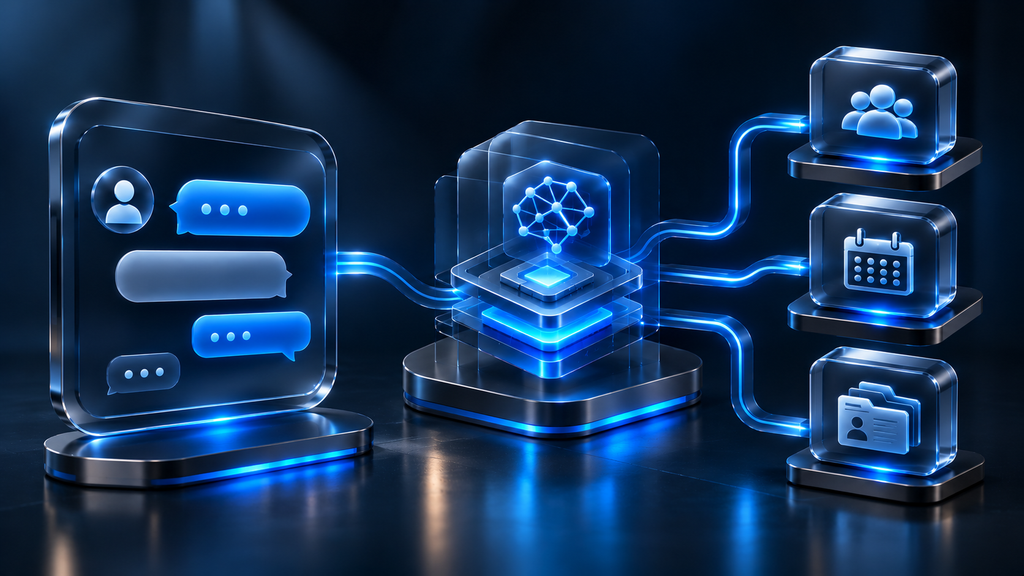
Yes. For some businesses, a hybrid approach makes the most sense.
A chatbot can serve as the customer-facing interface, while an AI agent handles approved tasks behind the scenes.
Example: A customer requests a consultation
Step 1 — Chatbot: The visitor asks about a service.
Step 2 — Chatbot: The system explains the service and collects basic information.
Step 3 — AI agent: The agent reviews the details and identifies the appropriate next action.
Step 4 — Connected workflow: The system checks an approved calendar or creates a CRM record.
Step 5 — Confirmation: The visitor receives the next steps, or the request goes to a team member for review.
The customer experiences one conversation, even though different systems handle different parts of the process.
This approach can work well when you need both clear communication and task completion.
It also allows you to keep predictable actions inside conventional workflows rather than giving every step to an agent.
AI Agent vs Chatbot Costs: What Should You Budget For?
The cost depends on the capabilities you need, the systems involved, and how frequently people use the solution.
There is no reliable universal price for either technology.
Typical chatbot cost factors
A chatbot project may involve:
- Conversation design.
- Knowledge-base preparation.
- Website or messaging platform setup.
- AI model usage.
- Customer support connections.
- Testing and content updates.
A chatbot that answers questions from a small knowledge base will usually have fewer technical requirements than one connected to multiple customer systems.
Typical AI agent cost factors
An agent may require:
- Workflow analysis and design.
- AI model usage.
- API and software connections.
- Secure access to business data.
- Tool permissions and approval controls.
- Error handling and monitoring.
- Testing across multiple scenarios.
- Ongoing maintenance.
The initial development cost is only one part of the budget.
You should also consider operating costs, supervision, and changes to your business processes.
How to compare value
Suppose your team spends 25 hours each month manually reviewing and routing customer enquiries.
A chatbot might reduce the time spent answering initial questions.
An agent might reduce some of the additional work involved in classifying enquiries, checking information, and updating records.
Neither saving is guaranteed.
To compare options, measure:
- Current time spent on the process.
- Percentage of tasks the proposed system can complete correctly.
- Time still required for human review.
- Monthly software and AI usage costs.
- Maintenance and support requirements.
The best solution is the one that delivers a worthwhile result at an acceptable cost and risk.
What Should You Consider Before Building Either Solution?
Define the business problem
Avoid starting with a broad request such as “We need an AI agent.”
Describe the work you want to improve.
For example:
“We need to respond to website enquiries, collect project requirements, and route qualified leads to our sales team.”
That gives you a clearer basis for choosing the technology.
Check your existing software
Identify which systems the solution needs to access.
This may include your website, CRM, calendar, email platform, or customer database.
Check whether those systems provide suitable APIs and permissions.
Prepare your business information
Chatbots and agents both depend on accurate information.
Review your service descriptions, policies, knowledge-base documents, and workflow rules.
Outdated information can produce poor results regardless of the technology.
Set limits on actions
Define which tasks the system may perform automatically.
For example:
- Answer approved service questions.
- Collect enquiry information.
- Create draft records.
- Request appointment availability.
- Ask for human approval before sensitive actions.
Limit access to the data and tools needed for the task.
Plan for errors and human handoff
Consider what happens when the system cannot understand a request, a connected application fails, or the customer needs a person.
A reliable design includes clear fallback paths.
Test with realistic situations
Test ordinary requests and difficult cases.
Include missing information, unusual wording, conflicting records, and attempted actions outside the system’s permissions.
Measure accuracy and task completion before expanding access.
Review performance after launch
Monitor the system’s responses, actions, errors, and costs.
Update it when your services, policies, or connected tools change.
At Polaris Avenue, our project process starts with understanding the requirements before selecting the technology.
What Does Current AI Agent Adoption Tell Us?
AI agents are moving into real business operations, but reliability remains a major concern.
LangChain’s 2026 State of Agent Engineering report surveyed more than 1,300 professionals.
Among respondents:
- 57.3% reported having agents running in production.
- 30.4% were developing agents with plans to deploy them.
- 32% identified quality as a leading barrier to production.
The results reflect the surveyed professionals, not every business in the market.
The lesson for business owners is practical: an AI agent’s ability to perform a task matters more than the number of features it advertises.
Before committing to a complex system, ask how its accuracy, failures, permissions, and completed tasks will be measured.
Frequently Asked Questions
Are AI agents better than chatbots?
Not automatically. AI agents can handle more complex, multi-step work, but chatbots may be a better fit for answering questions and guiding customers. The right choice depends on the task, budget, and level of control required.
Can an AI chatbot perform actions?
Yes. Some chatbots can book appointments, create tickets, retrieve records, or trigger predefined workflows. A chatbot does not automatically become an agent simply because it can call a tool. The difference depends on how it selects and manages actions.
Is ChatGPT a chatbot or an AI agent?
ChatGPT is an AI assistant with a conversational interface. Depending on its available tools and features, it can also perform agent-like tasks. The distinction depends on what actions a particular configuration can take.
Can small businesses use AI agents?
Yes. Small businesses may benefit from agents for tasks such as lead processing, customer enquiries, and administrative workflows. Start with a narrow use case and measure whether the results justify the cost.
Do AI agents cost more than chatbots?
Complex agents often require more development, connected systems, testing, and monitoring. A simple agent can cost less than a highly customized chatbot, so compare the actual project requirements rather than assuming one category is always more expensive.
Do I need both an AI chatbot and an AI agent?
Not necessarily. A chatbot may handle your needs, or an agent may operate without a customer-facing chat interface. Some businesses benefit from combining the two when they need both conversational support and multi-step task completion.
How long does it take to build an AI chatbot or agent?
The timeline depends on the scope, data readiness, software connections, approval requirements, and testing. A small knowledge-based chatbot may require less work than an agent connected to several business systems.
Final Verdict: Choose the Solution That Matches the Work
The difference between AI agents and chatbots is not simply which technology is more advanced.
It’s what each system needs to accomplish.
Choose a chatbot when your main goal is to answer questions, provide guidance, or collect information through conversation.
Choose an AI agent when your business needs software to interpret information, select actions, and complete multi-step tasks using connected systems.
Choose traditional automation when the process follows predictable rules.
And consider a hybrid approach when you need a conversational experience supported by task-oriented systems.
Start by identifying the problem, mapping the workflow, and defining the outcome you want.
That will help you invest in the capabilities your business actually needs.
Not Sure Whether Your Business Needs an AI Agent or Chatbot?
At Polaris Avenue, we design and develop AI solutions around real business requirements.
Whether you need a customer-facing chatbot, an AI agent connected to your CRM, or a more structured automation workflow, we can help you assess the options.
We’ll discuss your existing process, identify suitable opportunities, and explore an approach based on your goals.
Tell us what you’re trying to improve, and we’ll explore the next steps together.